
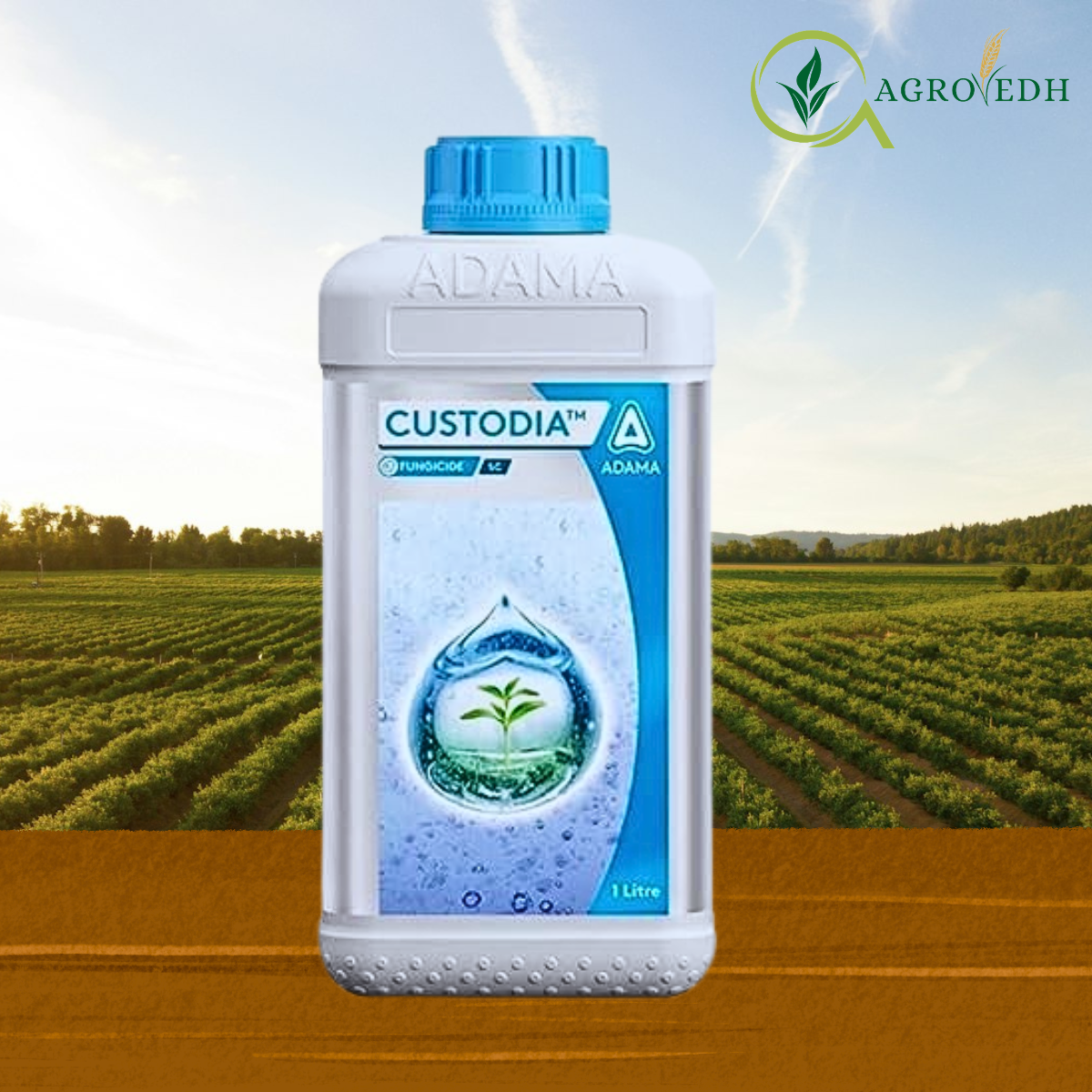
Custodia Fungicide
Custodia Fungicide is a premium broad-spectrum systemic fungicide powered by the advanced combination of Azoxystrobin 11% and Tebuconazole 18.3% SC. This dual chemistry provides preventive, curative, and eradicative control against a wide range of fungal diseases in high-value crops. By combining the strobilurin group (QoI inhibitor) with the triazole group (DMI inhibitor), Custodia ensures superior disease management along with strong resistance control strategy.
It is widely recommended for farmers growing grapes, chilli, tomato, paddy, and other horticultural crops where disease pressure is high and yield protection is critical.
Custodia Fungicide Product Overview
| Feature | Details |
|---|---|
| Product Name | Custodia Fungicide |
| Category | Systemic Fungicide |
| Technical Content | Azoxystrobin 11% + Tebuconazole 18.3% SC |
| Formulation | Suspension Concentrate (SC) |
| Mode of Action | Dual Action: QoI (Strobilurin) + DMI (Triazole) |
| Mobility | Systemic (Translaminar + Xylem Movement) |
| Toxicity | As per label classification |
Custodia Fungicide Features and Benefits
Dual Mode of Action
Azoxystrobin inhibits mitochondrial respiration in fungi (blocks electron transport chain at Qo site), while Tebuconazole inhibits sterol biosynthesis (demethylation inhibitor). This combination attacks fungi at two different biochemical sites.
Preventive, Curative & Eradicative Activity
Provides early-stage curative control and strong preventive protection when applied before infection.
Systemic and Translaminar Movement
Moves through leaf tissues and spreads via xylem, protecting both treated and newly emerging parts.
Broad-Spectrum Disease Control
Effective against Powdery Mildew, Anthracnose, Leaf Spots, Blast, Rust, Downy Mildew (crop-specific), and other major fungal pathogens.
Improved Crop Health & Yield
Azoxystrobin enhances physiological efficiency, improving green leaf retention and crop vigor.
Resistance Management Tool
Combination of two different FRAC groups (11 + 3) reduces resistance development risk compared to single-site fungicides.
Usage and Crop Recommendations
| Crop | Target Diseases | Dosage/Ha | Dilution in Water | Waiting Period |
|---|---|---|---|---|
| Grapes | Powdery Mildew, Downy Mildew | 600–800 ml | 500–1000 L | 14 Days |
| Chilli | Powdery Mildew, Fruit Rot | 600 ml | 500 L | 7 Days |
| Tomato | Early Blight, Powdery Mildew | 600–800 ml | 500 L | 7 Days |
| Paddy | Blast, Sheath Blight | 800 ml | 500 L | 21 Days |
| Mango | Powdery Mildew, Anthracnose | 600–800 ml | 500–1000 L | 14 Days |
Rain Fastness: Approximately 2–3 hours after spray.
Method of Application: Foliar spray using knapsack or power sprayer.
Best Time to Apply: Preventive spray or at first visible disease symptoms.
Technical
Azoxystrobin belongs to the Strobilurin class (FRAC Group 11) that blocks fungal respiration by inhibiting cytochrome bc1 complex. Tebuconazole belongs to the Triazole group (FRAC Group 3), inhibiting ergosterol biosynthesis, an essential component of fungal cell membranes. The combination ensures both energy disruption and membrane formation blockage, leading to complete fungal control.
Field trials across horticultural crops have demonstrated reduced disease incidence, improved green leaf area duration, and yield improvement when applied at early disease stages.
Safety and Handling
Use protective gloves, mask, and protective clothing during spraying.
Avoid spraying during high wind conditions.
Store in a cool and dry place away from food and feed materials.
Follow label instructions strictly before use.
Reviews
There are no reviews yet.